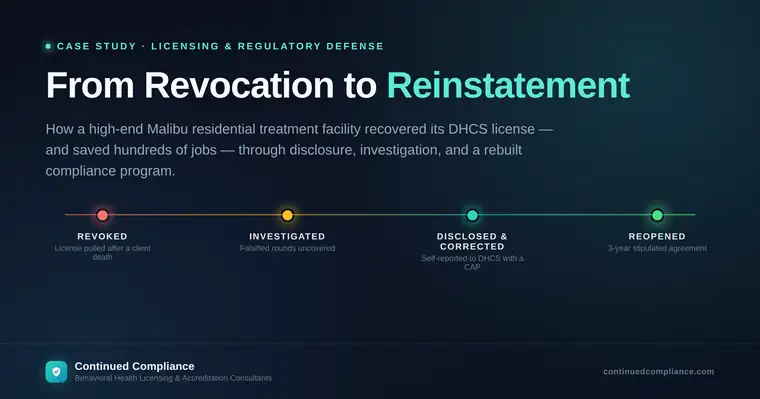
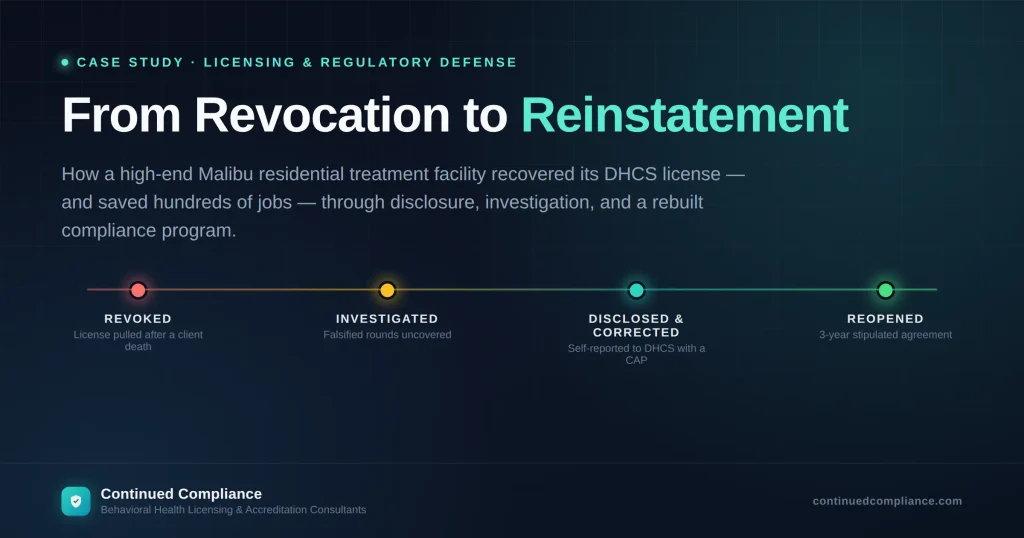
For any residential treatment provider, few words are more frightening than “license revoked.” For one high-end residential treatment facility in Malibu, California, that fear became reality after a client died in their sleep. What followed was a nine-figure question for the ownership group: was this the end of the facility, or the beginning of a harder, better version of it?
This is the story of how a thorough internal investigation, an uncomfortable decision to self-disclose, and a disciplined corrective action plan turned a California Department of Health Care Services (DHCS) license revocation into a stipulated settlement agreement, and saved hundreds of jobs in the process. We’re sharing it because the choices this facility’s leadership made under enormous pressure are choices every treatment provider, owner, and CEO should understand before they’re ever forced to make them.
The Incident
The facility had a client die in their sleep. It is the kind of event no treatment provider ever wants to face, and DHCS treated it with the seriousness it deserved. Following its investigation, the department revoked the facility’s license outright.
A revoked license is not a fine or a warning. It is a closure order. Every current client needs a new placement. Every admission stops. Every staff member’s job is suddenly in question. For a facility of this size, that meant hundreds of employees (clinicians, techs, support staff, administrators) facing the loss of their livelihoods over a decision that, at the time the license was pulled, had not yet been fully investigated on the facility’s own side.
That last point matters. DHCS’s revocation was based on the fact of the death and the regulatory violations its surveyors identified. What DHCS did not yet know (and what the facility’s own leadership did not yet know either) was how deep the underlying problem actually went.
Getting to the Truth: The Internal Investigation
When we were brought in, our first priority was not damage control. It was finding out exactly what had happened and why. That meant assembling a strong legal and compliance team and conducting a genuine internal investigation, not a defensive one.
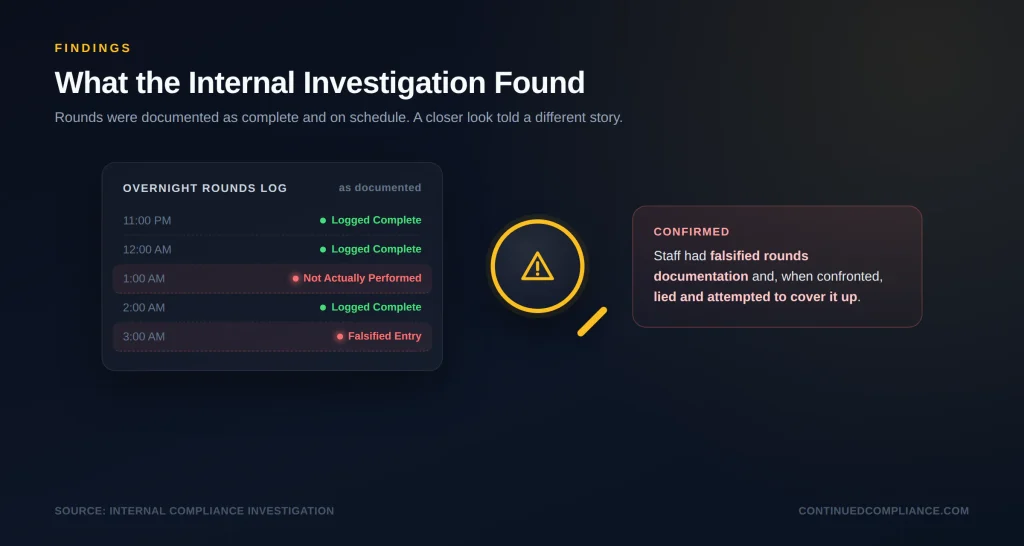
The facility’s written policies required documented rounds (regular, logged safety checks on every client, including overnight). On paper, those rounds had been performed according to policy. The logs said so.
The logs were wrong.
Our investigation uncovered that staff had falsified rounds documentation. Checks that were supposed to have been physically performed and logged in real time had not happened as recorded. When confronted, some of the staff involved lied about it, and there was an active effort to cover up what had actually occurred on the night in question.
This is the finding that changes everything about a case like this. A single tragic medical event is one thing. Falsified safety documentation and an attempted cover-up is another matter entirely, and it’s precisely the kind of finding that, if a regulator discovers it independently rather than hearing it from you first, can turn a difficult licensing action into a career-ending one for a facility and its leadership.
The Hardest Conversation: Getting Ahead of DHCS
Once we had the facts, we faced the hardest conversation of the entire engagement, and it wasn’t with the state. It was with our client.
Our recommendation was to proactively disclose the falsified-rounds findings to DHCS before the department found them independently. Understandably, the client did not want to do that. Self-reporting employee malfeasance to the same regulator that had just revoked your license is deeply counterintuitive. Every instinct says to minimize exposure, not volunteer more damaging information.
We advised strongly against that instinct, for one simple reason: DHCS was going to find it. Falsified documentation leaves a trail: inconsistent timestamps, staff interviews that don’t line up, physical evidence that contradicts the logs. A determined regulatory investigation, or a plaintiff’s attorney in subsequent litigation, was highly likely to surface the same facts we had just uncovered ourselves. The only question was whether DHCS would hear it from the facility, framed alongside a credible plan to fix it, or discover it independently, framed as concealment.
We impressed on the client that getting ahead of the finding was not just the more defensible legal position. It was the only path that gave DHCS a genuine reason to work with the facility rather than against it. Regulators distinguish, consistently, between providers who hide problems and providers who find and fix them. A facility that self-reports its own staff’s misconduct, backed by a real investigation and a real corrective action plan, is telling the regulator something important: the ownership takes this seriously enough to expose its own failures.
The client agreed to move forward with disclosure.
Building a Corrective Action Plan DHCS Could Trust
Self-disclosure only works if it’s paired with a corrective action plan (CAP) strong enough to justify the regulator’s confidence. A promise to “do better” is not a CAP. DHCS needed to see structural, verifiable change, the kind that doesn’t rely on the same staff behaving differently next time, but on new systems that make falsification far harder to repeat.
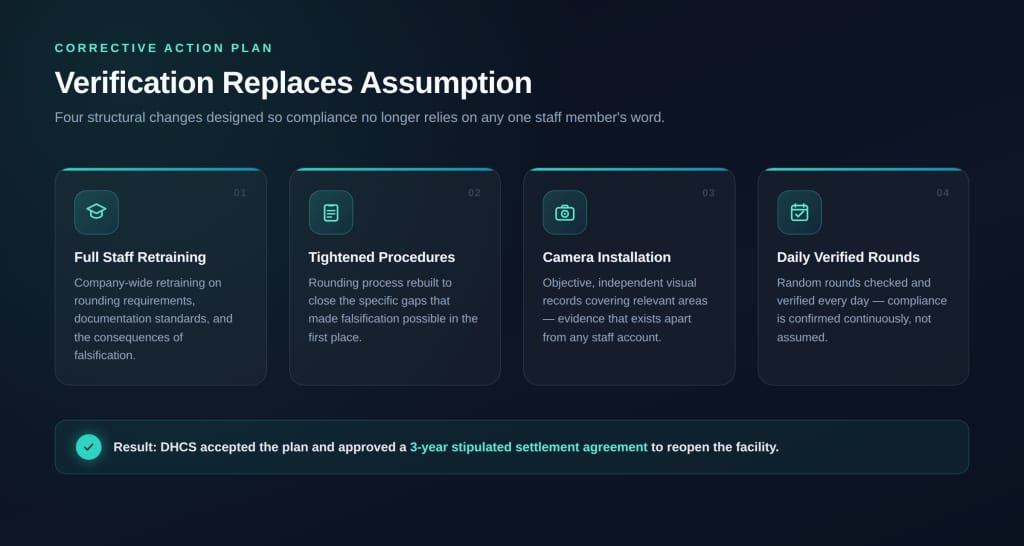
The corrective action plan we built with the facility included:
- Full retraining of all company staff on rounding requirements, documentation standards, and the seriousness of falsification, delivered as a documented, company-wide retraining initiative rather than a one-time refresher.
- Tightened rounding procedures, closing the gaps in the original process that had made falsification possible in the first place.
- Camera installation covering relevant areas, creating an objective record that exists independently of any staff member’s word.
- Daily verification of random rounds, so that compliance with the rounding policy was no longer something the facility simply trusted. It was something the facility actively checked, every day, on an ongoing basis.
Every element of the plan was designed around the same principle: verification instead of assumption. The original failure hadn’t just been that rounds weren’t performed. It was that no one was independently confirming that they were. The new system closed that gap permanently, not just for the duration of a settlement period.
The Outcome: A Stipulated Settlement Agreement
Armed with a completed internal investigation, full disclosure of the staff misconduct, and a strong, already-implemented corrective action plan, we were able to negotiate directly with DHCS on the facility’s behalf. The result was a stipulated settlement agreement: the department agreed to move the facility’s license status from revoked to open, under a three-year stipulated agreement with ongoing oversight conditions.
That outcome does not happen by accident, and it does not happen for facilities that fight the regulator or try to minimize what occurred. It happens when a licensee can show a regulator, with evidence, that it found the problem itself, fixed the systems that allowed it, and put permanent safeguards in place to prevent recurrence. DHCS’s willingness to reinstate the license under a stipulated agreement reflected genuine confidence that the facility that reopened was not the same facility that had failed.
The practical impact of that outcome was significant. Hundreds of employees kept their jobs. A facility with a strong clinical reputation remained available to the clients and families who rely on high-quality treatment options in the Malibu market. And today, that facility operates under a materially stronger compliance infrastructure than it had before any of this happened: camera-verified rounds, daily audit checks, and a staff culture that understands documentation integrity is not optional. It is, by every measure we track, now a bright star in the treatment industry rather than a cautionary tale.
What Every Owner and CEO Should Take From This
A few lessons from this case apply well beyond Malibu, and well beyond residential treatment:
“On paper” compliance is not the same as actual compliance. This facility had a rounding policy and logs that said it was being followed. That was not enough. If no one is independently verifying that documented practices are actually occurring, you don’t have a compliance program. You have a paper trail with a false sense of security. Random, verified checks and objective records like camera footage exist precisely to close that gap before it becomes a crisis.
Self-disclosure, done right, is a strategic asset, not a liability. The instinct to withhold damaging information from a regulator is natural, and it is almost always the wrong call when the information is likely to surface anyway. Regulators are not looking for perfect providers. They are looking for providers who respond to failure with honesty and rigor. A facility that gets ahead of its own bad news, backed by a credible investigation and a real fix, gives the regulator a reason to be a partner in reinstatement rather than an adversary in enforcement.
A corrective action plan is only as strong as its verification mechanism. Retraining matters. Tightened procedures matter. But the element that actually changes behavior long-term is ongoing, independent verification (daily audits, cameras, spot checks) because it removes the possibility of the same gap reopening quietly once regulatory attention fades.
The stakes are almost never just about the license. Behind every licensing action are the clients who need care, the staff who depend on their jobs, and the reputation a facility spends years building. Treating a licensing crisis purely as a legal problem to be won or lost misses the larger responsibility ownership has to everyone connected to the facility.
You don’t have to navigate this alone, and you shouldn’t. The difference between a revoked license that stays revoked and one that becomes a stipulated settlement agreement often comes down to the quality and credibility of the investigation, the disclosure strategy, and the corrective action plan behind it. That is specialized work, and it is far more effective handled by people who do it regularly than reconstructed under pressure for the first time during a crisis.
No treatment provider wants to face a call from DHCS about a revoked license. But if that call comes, how leadership responds in the first weeks (whether they investigate honestly, disclose proactively, and rebuild with real verification rather than promises) determines whether the story ends in closure or in reinstatement. This facility chose the harder, more honest path. Hundreds of jobs, and a genuinely stronger organization, are the result.
If your facility is facing a licensing action, survey finding, or the aftermath of a sentinel event, Continued Compliance works with residential and outpatient behavioral health providers nationwide to investigate, disclose, and rebuild compliance programs that regulators trust. Reach out to discuss your situation before it becomes a crisis you’re managing alone.
For the general process behind a case like this, see How to Restore a Revoked Facility License. For how California’s incident reporting timeline applies when a death occurs at a licensed facility, see DHCS Mandatory Incident Reporting: What BHIN 26-007 Changed.